I remember a young brother in my home congregation once giving an Instruction Talk during the old Theocratic Ministry School format. Dan was a relatively new Ministerial Servant and, to the best of my recollection, this was his first talk of this type.
He used an effective illustration of a bag of candy that one may think was empty, but actually contained a lone treat if one was willing to check thoroughly. With his illustration, he was drawing a correlation to theocratic knowledge. When we think we've taken every last bit of understanding from a topic, looking once more could yield a small morsel of enlightenment.
And then I remember that this blog is about Jehovah's Witnesses...
C.T. Russel had embarked on his mission to expose bible truth through exhaustive scriptural examination. His fledgling Society had the admirable mission of making Christianity purely Christian. That meant excising pagan practices, false teachings, misunderstandings, and baseless tradition. Almost brilliant in its simplicity. But nearly one-hundred years later, young Ministerial Servant Dan stood on the dais and expounded on the virtues of exhaustive examination, while disturbingly ignorant of his religious foundations.
As Witnesses, we once proudly claimed to have stripped away all the practices that were not biblical in nature. We, almost haughtily, professed that we were the only true Christians left in the world. But we had actually returned to the evolving roots of all religions. What Pastor Russel had set out to do in the late 1800's had been forgotten. Replaced with new understandings, the current beliefs of Jehovah's Witnesses are ones that Russel would not recognize.
Over the decades, Witnesses have modified their beliefs to include practices once thought to be unscriptural. Blood transfusions are an easy example. Taking literally the admonitions not to consume blood as a biblical prohibition of medical blood transfusions, hundreds or thousands of Witnesses have denied this proven medical treatment for the fear of eternal destruction. The policy was to disfellowship anyone who accepted this proven medical procedure. The new stance is that it wont get you disfellowshipped. It would seem that the Governing Body no longer feels it will cost a person eternal paradise. Whether they erred in issuing the old policy or the new, and one of them is certainly wrong, the bible has rules about accidental blood-guilt.
That's not really the point here. Blood transfusion, along with every other baseless stance, are tangents of a much bigger problem. Watchtower belief systems have expanded over time. They are tweaked to close gaps, explain inconsistencies, and make exceptions... Just like every other religion.
While at one time Witnesses may have moved in the right philosophical direction in removing those Old World, non-Christian practices, new ones are now just as tightly woven into their beliefs as those they sought to remove. So what progress has actually been made?
To be frank, none. It's the same old song-and-dance. Indecision about blood transfusions, the repeated revision of the 1914 Generation doctrine, financial consolidation, child abuse scandals, power struggles, organizational splits, government collusion, scientific suppression... the list goes on for quite a while. And it all points to the same thing - Jehovah's Witnesses, as an organization, are as likely to veer off course as any other mainstream religion.
Religious organizations peddle fairy tales as fact that no one really wants to dispute, and being a system of cognitive stasis at their core, they are dependent on followers who don't ask questions. It's the ultimate long con. One would think we'd have looked behind that particular curtain by now, so why does it persist?
Conformity with social groups, even in the face of empirical falsehood,
is usually the safer bet for the individual. It doesn't accomplish much to be an outlier
because of an inconsequential point of contention, and psychological
experiments have demonstrated that even clearly false information is
readily assimilated by people to avoid becoming an outcast. This
acceptance of group paradigms is known as conforming behavior.
Harvard's Herbert Kellman has identified a number of these
behaviors, of which Internalization is the most common. Internalization
is analogous to "making the truth your own". It is the practice of
making beliefs integral to one's thought processes. Other conforming
behaviors may only be an external display, but Internalized beliefs have
the deepest and longest lasting hold. Also called Informational Social
Influence, subjects turn to peers for accepted truth by which to guide
their own thinking. Our experience among Witnesses is hard to
characterize any other way. The Society is very clear that Witnesses
must be unified in their thinking, and seeking outside validation is
reason enough to be shunned.
We sometimes refer to this dedication to the charade as "drinking the
kool-aid". It's most predictable in groups that also restrict your socialization outside the group. The aforementioned conforming behaviors become requisite in the face of banishment. Time and again, we encounter former Witnesses who have struggled to cope with living in a new and strange social environment. Hardly a one of us will claim that it was easy to make that transition. Sadly, far too many of us have fallen to destructive coping mechanisms like drugs or alcohol, or even suicide.
It's humbling to admit that we were duped for as long as we were. But the comforting thing is that its in the past. No one there can impede our progress forward into an enlightened and fulfilling life.
What else could smell as sweetly?
Monday, October 16, 2017
Monday, August 7, 2017
Breaking Cycles, Part 2

In the previous post, I discussed the problem of inviting hurt into our lives by dwelling on injuries of the past. It really shouldn't be any surprise that feeding that flame of resentment is toxic. It steals our joy from us, prevents us from pursing our nature, and renews the victimization we once suffered.
Other reflections are for the purpose of ignoring certain realities. The Watchtower Society spends inordinate amounts of time and column inches extolling the virtues of meditation. Constant reflection on God's word, and the extra-biblical publications distributed by Witnesses, are the only way to prevent consumption by this wicked system. Why, it's best to start the day with spiritual reflection, and on your coffee break. May as well bring the iPad in the can with you so you have something wholesome to read while you do something unclean.
These practices serve as blinders. Their sole, and very effective, purpose is to completely occupy one's time so that critical thought is a practical impossibility. There just isn't time to examine anything else.
For one reason or another, we all went searching for more information. For my part, I was simply lazy and didn't care about the Society in my twenties. I was content to be unplugged from the constant reminder that I was sinful and inadequate. It wasn't yet important to me to really validate what I knew or didn't know about the Society. That would come later.
All I could be bothered with at the time was avoiding discussions about my past as a Witness and, with far more determination, preventing a future as a Witness. Even hearing the word "witness" from the television caused me substantial anxiety. I wish that was a joke. It's this particular trigger word that has largely prevented me from enjoying crime dramas.
It took time to learn to think again. The once pervasive reminders I endured of Christian thinking were harder to slough off than I'd like to admit. Keywords, like the one above, practiced responses, patterns of speech... all of it had to be unlearned. Oddly, defending other religions was even a practice I had learned. It was ingrained in me to defend the right to believe, even if it was a contending faith. Thus, when the documentary Going Clear debuted on HBO, I was hesitant to watch. But I did.
By the end of it, I was shaking with fury over the undeniable similarities shared between Scientologists and Jehovah's Witnesses. No, we're not talking about anything so trite as a religious belief. We're talking about the hierarchy of their organization, their own jargon, prevention of free thought, and expulsion of apostates. In either case, you could transplant the beliefs of one into the organizational structure of the other and still have a functional tax shelter.
Here's the thing that really only starts to make sense when you've been away from it for a while. Witnesses could be asked to compare their beliefs and practices with Scientology, and I'm certain that they would almost unanimously agree that there were no comparisons to be had. What they would say Scientology does is to pervert faith and belief. But what they would say Witnesses do is to protect their Christian brotherhood. In actuality, the only differences between the two are the jargon they use to embody the philosophies of these practices.
SEAORG, for example, is the equivalent of Bethel. Both encompass the managerial departments and personnel of daily operations, including Ecclesiastical development. Members of both are permitted to marry, but must resign if they wish to have children. Both work unusually long hours in performance of their duties. Both are given small allowances for basic needs. Both are provided room and board as part of their service. These are functionally the same entities under different names.
What Witnesses call "apostates", Scientology calls "suppressive persons". These people are shunned by other members of the church; often losing contact with faithful family members, and enduring legal battles to maintain custody or contact with minor children.
Dissenting thought is not permitted. Openly questioning the teaching of the church is not permitted. There is no transparency above the level or position a person occupies in the church at any given time. There is no financial accountability.
But as long as one persists in the cycle of reinforcement, none of these glaring issues is worth examining. They are casually dismissed, explained away, or ignored wholesale. It is the goal of this indoctrination to make followers so incredulous of the outside world that any challenge is avoided. Watchtower has become very good at this. Very good. So good, in fact, that followers must often resort to semantics to differentiate themselves from "false religion".
For example, Witnesses do not "shun". They "disfellowship". Disfellowshipping is the prohibition of contact with rebellious, unrepentant sinners. Thus, the disfellowshipped person is not allowed to pollute the spirituality of obedient members of the church. Now if that sounds a lot like shunning, don't be alarmed. Except for being exactly alike in practice, they have nothing in common.
See? Semantics.
The cycle is one of denial. Denial of understanding. Denial of truth. Denial of reality. For as long as a person commits themselves to that cycle, there is no opportunity for growth.
Damn. To be honest, I wish I could go back to the start of my life and hit the reset button. Who knows what kind of person I could be now if I hadn't been strapped on that merry-go-round so early in my life.
I've got no clever turn of phrase to express that...
Friday, July 21, 2017
Breaking Cycles
I try to be active in the ex-JW community for the sake of those mired in their hatred of the Society. The sad reality is that there are a vast majority who have become stuck in a cycle of animosity towards Watchtower. That animosity certainly has merit, but I'm reminded that we sometimes assimilate that into the very definition of ourselves.
We probably know people who tell the sames stories, make the same complaints on a daily basis. The subject matter isn't actually important, but the fact that it occupies so much of their time and personal context that it is actually part of their fabric. Dyed in the wool, as it were.
The closest correlation that I personally have is actually at the opposite end of the emotional spectrum. As a teen, I developed an intense crush on a young sister that was close friends with my cousin. We became friendly ourselves, eventually becoming pen pals and writing letters for nearly two years. To say that I loved her would be accurate, if not a little askew. Those feelings were one sided, as they often are, and I was left contending with this pervasive occupation of my thoughts.
At least for a time...
That crush eventually began to wane, but I was not ready to let go of it. She had been my very first serious romantic interest, and that was precious to me. So much so that I was distressed at the thought of losing it. Even as unfulfilling as it was to be the only one who felt it, the idea of letting it diminish caused physical anguish. That led me to a cycle of self-abuse that itself was difficult to break.
This being back in the days when cell phones were also handy bludgeoning tools, I had a few photographs from her high school to keep the image fresh in my mind. When I felt the rush of my feelings beginning to fade, I would look at those images and dwell on the small amount of time we'd spent together. I was willing myself to feel emotions that had long passed their sell-by date. I was hurting myself because I somehow concluded that overcoming those feelings somehow stole something from me, and that thought terrified me.
I see the same pattern of behavior occurring among apostates. Complaints that are years or decades old are still being repeated. This is usually knowledge that is part of the compendium of apostate information. It's even in the Welcome brochure... But some people are so inured to this information that they cannot pass an opportunity to wallow in it again, leaving behind the same comments they've left for years, renewing the acuteness of their hatred.
Like me and those school photos, apostates often absorb and dwell upon those words that once so succinctly enveloped the depth of their despair towards Watchtower. They stare at that old injury until their memory is keen enough bring back the hurt that went with it. Thus, they start the cycle anew.
It may all seem rather obvious, but that isn't healing. True healing comes in the form of letting the past be past. Purposely inviting hurtful histories into the present forces us to relive the injury and go through the healing process again. With it, you have the same emotional burdens.
I think we all want to be free of Watchtower, but far too many of us keep inviting them back to relive old times. What we lived through certainly shaped us, but it doesn't define us, and we don't have to give Watchtower that leverage over us. Look for ways to be productive, to use you experiences to help other people. That is the biggest middle finger you can give them.
We probably know people who tell the sames stories, make the same complaints on a daily basis. The subject matter isn't actually important, but the fact that it occupies so much of their time and personal context that it is actually part of their fabric. Dyed in the wool, as it were.
The closest correlation that I personally have is actually at the opposite end of the emotional spectrum. As a teen, I developed an intense crush on a young sister that was close friends with my cousin. We became friendly ourselves, eventually becoming pen pals and writing letters for nearly two years. To say that I loved her would be accurate, if not a little askew. Those feelings were one sided, as they often are, and I was left contending with this pervasive occupation of my thoughts.
At least for a time...
That crush eventually began to wane, but I was not ready to let go of it. She had been my very first serious romantic interest, and that was precious to me. So much so that I was distressed at the thought of losing it. Even as unfulfilling as it was to be the only one who felt it, the idea of letting it diminish caused physical anguish. That led me to a cycle of self-abuse that itself was difficult to break.
This being back in the days when cell phones were also handy bludgeoning tools, I had a few photographs from her high school to keep the image fresh in my mind. When I felt the rush of my feelings beginning to fade, I would look at those images and dwell on the small amount of time we'd spent together. I was willing myself to feel emotions that had long passed their sell-by date. I was hurting myself because I somehow concluded that overcoming those feelings somehow stole something from me, and that thought terrified me.
I see the same pattern of behavior occurring among apostates. Complaints that are years or decades old are still being repeated. This is usually knowledge that is part of the compendium of apostate information. It's even in the Welcome brochure... But some people are so inured to this information that they cannot pass an opportunity to wallow in it again, leaving behind the same comments they've left for years, renewing the acuteness of their hatred.
Like me and those school photos, apostates often absorb and dwell upon those words that once so succinctly enveloped the depth of their despair towards Watchtower. They stare at that old injury until their memory is keen enough bring back the hurt that went with it. Thus, they start the cycle anew.
It may all seem rather obvious, but that isn't healing. True healing comes in the form of letting the past be past. Purposely inviting hurtful histories into the present forces us to relive the injury and go through the healing process again. With it, you have the same emotional burdens.
I think we all want to be free of Watchtower, but far too many of us keep inviting them back to relive old times. What we lived through certainly shaped us, but it doesn't define us, and we don't have to give Watchtower that leverage over us. Look for ways to be productive, to use you experiences to help other people. That is the biggest middle finger you can give them.
Monday, July 17, 2017
And We Had a Gay 'Ol Time

It's Pride month for the LGTBQ community around the country, if not the world. They're in the midst of taking the lime light and being loved for who and what they are. This past weekend, I was blessed enough to take my own son to revel in the self-acceptance that filled the air and streets of San Diego.
Being raised as one of Jehovah's Witnesses, I was taught to dislike the LGTBQ community, not on the merits of their character, but on the abstract value of their activities. In the mythos of Abrahamic religion, the first of the Bible's Gods rained down fire and sulfur upon Sodom and Gomorrah in retribution for their supposed sins. We all know the story, though some forget that Lot and his daughters ended up knocking boots in a cave shortly after the aforementioned razing. I may be mistaken, but I think incest was also prohibited by Mosaic law. Neither here nor there, since the narrative makes it clear that God was okay with this, but all three of them should have been pulled down on the carpet for those shenanigans. Lets just make that a punch list item to address at Judgement Day...
 I'm at somewhat of a loss, though. Apologists for the Bible believe that even though Jesus didn't mention anything about homosexuality in the gospel accounts, he still addressed it by inspiring Paul to later mention in throughout his letters. Barring the other obvious differences between the teachings of Jesus and Paul, there were three years of Jesus ministry encompassed in the gospels. Do they really mean to imply that Jesus didn't have the time to mention something that takes up so much column space in later bible books?
"Don't have sex with the same gender..." There! Was that hard? No, of course not. Yet Jesus never took the time to mention it. Also, in inspiring the Gospel recollections of Matthew, Mark, Luke, and John, it wasn't worth writing down. It was, however, for Paul; the apostle that never traveled with the Savior.
As we say back home, where the gene pool is shallower, "that dog don't hunt."
The entire idea of Christianity is that Jesus was the Great Teacher. If there was a lesson that he didn't teach, how is it proper to infer the lesson ex post facto? I don't really think that it is, but that is admittedly an opinion. However, I will point out that many of the lessons that came both before and after Jesus are infinitely more complicated and restrictive. [Insert sarcasm font] Nothing like the Pharisees against whom he spoke...
So let me tell you what I observed at the Pride festival this year.
Love. Lots of love.
What? Too simple? Okay, you have me there.
I was a guest among chosen family, firstly. While I have intimate ties with my traveling companions, our hosts, Randy and Chuck, hardly know me from Adam. All the same, they extended to me the same hospitality that they did countless strangers. At a charming Craftsman on Lincoln, the "uncles" happen to have ring-side seats for the staging area of just one arm of the parade procession. For the people who congregate there to prepare for their march, Chuck and his husband of 35 [or so] years, Randy, provide Bloody Caesars (a much improved version of a Bloody Mary) and open their home to anyone on the street.
 Secondly, the people on the street were there to represent the diversity human existence. No matter how vanilla I may seem to be, I am part of that great diversity, and am thus as joyfully embraced. I encountered people of every preference and proclivity. Each one of them smiled at me and my mundanity just as sincerely as at each other. They were gracious and cheerful, standing for pictures, and encouraging unflinching acceptance.
And here's the icing on the cupcake, as it were... Everyone mattered. Every color, gender, preference, expression of human identity mattered. And this is where I felt humbled. I, me, the person I've grown to be, has always felt a special fondness for this version of the human self, which is but a mote of dust on the pallet of human color. But they were just as joyful for my blandness as for their own brilliance.
 What is magical about something like this experience is that people like this, who are this joyful, this loving, is that they bring out your own inner light. You feel yourself become brighter with their smiles and flair.
The manner in which most of us were trained sent us on a quest for God's grace. I don't believe in that the way I once did. I'm rather of the opinion now that the search for it kept me from seeing it all along. If I'm to believe my own observation, I imagine that this experience is what that grace would feel like.
Thursday, June 22, 2017
The Problem With Absolutes
I've tried to be emotionally neutral about being a former Witness. There isn't much good that comes from harboring unending anger towards an organization that, at the institutional level, hasn't two shits to give about my opinion. Likened to drinking poison and hoping your enemy dies, expecting them to change because of my hurt feelings is foolish. It's another example of external control psychologies that permeate society.
Sometimes, though, I think that anger has a place; particularly in the face of injustice. Humans are keen to disparities and abuses of favor. It isn't hard to spot when a person is receiving preferential treatment, and it doesn't take long for us to get tired of it. But it is so pervasive that we can see it at every level of our social structure. Carried to an extreme, it even constitutes violations of civil rights.
This is not that extreme. It's just hypocritical bullshit, unfortunately.
When I disassociated myself a few months ago, I did the superlative favor of informing my family personally, instead of having them find out through congregational back-channels. I fully understood where that would lead, and the familial bonds suffered predictably. Most of us already comprehend the depth of pain shunning can bring, so there's no need to expound on it here. We understand that there is no right of birth or basic human dignity that cannot be undone by a firmly held belief. But how and what should you feel when that belief is only as firm as the perceived offense to the shunning party's religious pride?
You see, I was raised by a mother that is really only concerned about the outward appearance of comparative piety. Were I simply inactive, it could be plausibly denied that I was an apostate, but sending that letter removed all doubt. The whole of the Organization now knows that she and my former-elder father had failed as Christian parents. Shunning is the only way they save face.
I know, that in itself is not exactly an inequity. I knew what the price would be to disassociated, and I accept that. But we also know that even tangential choices can be called into question by the congregation. Our rejection of worldly practices was supposed to be so absolute that we didn't utter holiday greetings, participate in holiday parties, or encourage the celebration thereof. I knew of households so strict about this policy that even using the word "Christmas" was verboten, being replaced instead with "X-mas" (the topic of substitute swear words also comes to mind).
So this past Father's Day, while I spent the day with my son, and neither hearing from, nor contacting, my own father, I was a bit surprised by my cousin's Facebook post to her father. Now, don't let me give the false impression that my cousin or my uncle are in the wrong. They are not Witnesses. Never were. And while she didn't specifically say "happy Father's Day", it was posted on Sunday and written directly to her dad. It was sweet, appreciative, and loving.
There, as a subscript to the post, was a heart. The heart was placed there by my mother.
It was small. Likely, no other person in the world would even care. There could be no mistaking its intent, however. My mom was endorsing a worldly holiday observance. Although it was for her non-Witness brother, it was no less complicit.
Alright... so that's how it is...
Witnesses are acutely aware that they should be acutely aware of hypocrisy. Jesus was very aware of it and pointed it out frequently. I used my better judgement and did not hijack well-wishes meant for my uncle to point out my mom's hypocrisy. But I admit, I did fume over it for a while. One is either fully invested or divested from the faith if it's to have any integrity. A little bit of straying from the path is still straying and, as my mom demonstrated, integrity is apparently contextual.
This has been one of my biggest bones of contention since I first entertained the idea of disassociation. Why? Well shunning typically arises from the dedication to moral philosophies which stand in opposition to those doing the shunning, and it is absolute. There is no wiggle room. Shunning is not invoked for something as paltry as liking a Father's Day wish, but the rejection of the holiday as a Christian activity is similarly absolute. So I'm left wondering which part of that is okay...
The thing is that it's not okay. A legitimate complaint could be lodged about this, but that brings me back to how I started this entry. Is it worth being angry about it? Does a person who doesn't have the integrity to treat everyone outside themselves with consistency deserve my energy? To be succinct, no. The don't deserve it. We have no duty to direct any of our energy to them. It certainly may be worth it if it is in alignment with our greater goals (such as spending time to write about it for other apostates), but we're under no obligation.
For me, this is just another ember in the burning bridge that tied my potential to the prison of constrained thought. The energy that I give to this is actually for the benefit of those still seeking the freedom of an unencumbered spirit. That's my greater goal. I have a deep and abiding distaste for bullies, and there is nothing quite as brutish as isolating a person because of their transient contextual differences while only pretending to have the high ground.
Sometimes, though, I think that anger has a place; particularly in the face of injustice. Humans are keen to disparities and abuses of favor. It isn't hard to spot when a person is receiving preferential treatment, and it doesn't take long for us to get tired of it. But it is so pervasive that we can see it at every level of our social structure. Carried to an extreme, it even constitutes violations of civil rights.
This is not that extreme. It's just hypocritical bullshit, unfortunately.
When I disassociated myself a few months ago, I did the superlative favor of informing my family personally, instead of having them find out through congregational back-channels. I fully understood where that would lead, and the familial bonds suffered predictably. Most of us already comprehend the depth of pain shunning can bring, so there's no need to expound on it here. We understand that there is no right of birth or basic human dignity that cannot be undone by a firmly held belief. But how and what should you feel when that belief is only as firm as the perceived offense to the shunning party's religious pride?
You see, I was raised by a mother that is really only concerned about the outward appearance of comparative piety. Were I simply inactive, it could be plausibly denied that I was an apostate, but sending that letter removed all doubt. The whole of the Organization now knows that she and my former-elder father had failed as Christian parents. Shunning is the only way they save face.
I know, that in itself is not exactly an inequity. I knew what the price would be to disassociated, and I accept that. But we also know that even tangential choices can be called into question by the congregation. Our rejection of worldly practices was supposed to be so absolute that we didn't utter holiday greetings, participate in holiday parties, or encourage the celebration thereof. I knew of households so strict about this policy that even using the word "Christmas" was verboten, being replaced instead with "X-mas" (the topic of substitute swear words also comes to mind).
So this past Father's Day, while I spent the day with my son, and neither hearing from, nor contacting, my own father, I was a bit surprised by my cousin's Facebook post to her father. Now, don't let me give the false impression that my cousin or my uncle are in the wrong. They are not Witnesses. Never were. And while she didn't specifically say "happy Father's Day", it was posted on Sunday and written directly to her dad. It was sweet, appreciative, and loving.
There, as a subscript to the post, was a heart. The heart was placed there by my mother.
It was small. Likely, no other person in the world would even care. There could be no mistaking its intent, however. My mom was endorsing a worldly holiday observance. Although it was for her non-Witness brother, it was no less complicit.
Alright... so that's how it is...
Witnesses are acutely aware that they should be acutely aware of hypocrisy. Jesus was very aware of it and pointed it out frequently. I used my better judgement and did not hijack well-wishes meant for my uncle to point out my mom's hypocrisy. But I admit, I did fume over it for a while. One is either fully invested or divested from the faith if it's to have any integrity. A little bit of straying from the path is still straying and, as my mom demonstrated, integrity is apparently contextual.
This has been one of my biggest bones of contention since I first entertained the idea of disassociation. Why? Well shunning typically arises from the dedication to moral philosophies which stand in opposition to those doing the shunning, and it is absolute. There is no wiggle room. Shunning is not invoked for something as paltry as liking a Father's Day wish, but the rejection of the holiday as a Christian activity is similarly absolute. So I'm left wondering which part of that is okay...
The thing is that it's not okay. A legitimate complaint could be lodged about this, but that brings me back to how I started this entry. Is it worth being angry about it? Does a person who doesn't have the integrity to treat everyone outside themselves with consistency deserve my energy? To be succinct, no. The don't deserve it. We have no duty to direct any of our energy to them. It certainly may be worth it if it is in alignment with our greater goals (such as spending time to write about it for other apostates), but we're under no obligation.
For me, this is just another ember in the burning bridge that tied my potential to the prison of constrained thought. The energy that I give to this is actually for the benefit of those still seeking the freedom of an unencumbered spirit. That's my greater goal. I have a deep and abiding distaste for bullies, and there is nothing quite as brutish as isolating a person because of their transient contextual differences while only pretending to have the high ground.
Friday, June 2, 2017
The Wheat and the Weeds
One of the conundrums of being a Christian is the [sometimes] explicit belief that God has a purpose for everything in creation. It was not an accident that the stars align the way they do, that the moon orbits where it does, or that there are dandelions in your yard. There were no accidents listed in Genesis. There were no footnotes explaining the exceptions. God made what He did with intent and forethought. That brings up a very worthwhile question about people who choose to follow the teachings of the Society and those who don't.
Don't all have a role to play in God's purpose for the Earth?
We all remember the parable known by the title of this entry. A servant of God sowed figurative wheat in a field. While he later slept, another came and sowed weeds among the wheat. The undesirable weeds became intertwined with the wheat and could not be plucked without also risking the wheat.
Often, those of the apostate crowd are likened to the weeds. We grew spiritually with the faithful, and though we were known to be different, we were allowed to continue until we were mature enough to be harvested along with the ripened wheat and duly separated. The weeds have no value, after all. Except... see the comment above about all of creation having a purpose.
Weeds are sometimes the only thing that will grow in an inhospitable environment. Where water is scarce, the thick and tenacious roots dig deep underground to find it. The prickly and dense leaves protect them from the scorching sun or hungry animals. They bloom flowers to attract bees that are responsible for most of the pollination world wide. They anchor the soil to prevent erosion from wind and rain. Weeds are necessary.
Accepting that this unfortunate child of creation has an undeniable and critical function in our ecosystem, is it fair to discriminate against them simply because they're hardy and coarse? Perhaps not, but we were taught to dismiss them anyway. We develop products to selectively eradicate them. We pay our children to go out and pull them for a modest fee. It is culturally normal and acceptable to exclude weeds from our gardens and yards.
Isn't that bucking God's purpose? It's kind of a subtle middle finger to the Creator if you think about it. And since we, the weeds, are part of creation and therefore from God, what is our purpose?
We all live under the burden of other people who think they are better than us. Some are vocal about it. Others, less so. It stems from the mistaken assumption that living is a competition. For them to have what they want, they believe (because they are taught to) that we must go without. In the case of Witnesses, they also mistakenly believe (because they are taught to) that they are the only source for what we want.
Our indoctrination often included anecdotal evidence that people who left the Society were miserable. This was not without merit, since we'd also been indoctrinated to find happiness in the company of spiritual brothers and sisters. In taking that away from us, they also took our happiness. The Society, intentionally or not, taught us how to imprison our own minds.
I've previously written on the concept of scotoma. It is a fancy word that encompasses a mental "blind spot" of sorts. Some may phrase it as the mind "seeing what it wants to see". I prefer to think of it as a barrier that is present only in the abstract and that we cannot see around. You know, for example, that you cannot lift a five-hundred pound barbel. Any object that you mistake for a five-hundred pound barbel will be immovable because you are mentally adamant that you cannot lift it. This phenomenon has been proven under hypnotic suggestion, so there is scientific basis for the claim.
In a similar fashion, being programmed with the mental scotoma that you cannot be happy without the association of your spiritual family can effectively prevent you from finding it. But remember that you have been classified as an undesirable weed by people who accept that everything in creation has a purpose... except you. They invalidate their own belief.
Here's the good news. Scotoma are entirely voluntary. You can get rid of them if you want to. First, be accepting that you are good. You have purpose, which no other person may define. Secondly, there are sources of happiness out there that do not rely on the fickle associations of common faith. Choose to surround yourself with people who reflect your values. It's not difficult. In seeking out that which speaks to you, you will encounter those who share your vision. Embrace them. Remember that your happiness comes from being you. Not from being who someone else wants you to be. And people who share your values will not ask you to change for them.
As you move forward in your journey, with or without the association of Witnesses, remember that no one gets to define you, except you. It is not within the grasp of any other person to understand your purpose, or quantify your value. If they do not see you as wheat, it is simply because they have not yet discerned what you bring to the table. And that failing is entirely theirs.
Don't all have a role to play in God's purpose for the Earth?
We all remember the parable known by the title of this entry. A servant of God sowed figurative wheat in a field. While he later slept, another came and sowed weeds among the wheat. The undesirable weeds became intertwined with the wheat and could not be plucked without also risking the wheat.
Often, those of the apostate crowd are likened to the weeds. We grew spiritually with the faithful, and though we were known to be different, we were allowed to continue until we were mature enough to be harvested along with the ripened wheat and duly separated. The weeds have no value, after all. Except... see the comment above about all of creation having a purpose.
Weeds are sometimes the only thing that will grow in an inhospitable environment. Where water is scarce, the thick and tenacious roots dig deep underground to find it. The prickly and dense leaves protect them from the scorching sun or hungry animals. They bloom flowers to attract bees that are responsible for most of the pollination world wide. They anchor the soil to prevent erosion from wind and rain. Weeds are necessary.
Accepting that this unfortunate child of creation has an undeniable and critical function in our ecosystem, is it fair to discriminate against them simply because they're hardy and coarse? Perhaps not, but we were taught to dismiss them anyway. We develop products to selectively eradicate them. We pay our children to go out and pull them for a modest fee. It is culturally normal and acceptable to exclude weeds from our gardens and yards.
Isn't that bucking God's purpose? It's kind of a subtle middle finger to the Creator if you think about it. And since we, the weeds, are part of creation and therefore from God, what is our purpose?
We all live under the burden of other people who think they are better than us. Some are vocal about it. Others, less so. It stems from the mistaken assumption that living is a competition. For them to have what they want, they believe (because they are taught to) that we must go without. In the case of Witnesses, they also mistakenly believe (because they are taught to) that they are the only source for what we want.
Our indoctrination often included anecdotal evidence that people who left the Society were miserable. This was not without merit, since we'd also been indoctrinated to find happiness in the company of spiritual brothers and sisters. In taking that away from us, they also took our happiness. The Society, intentionally or not, taught us how to imprison our own minds.
I've previously written on the concept of scotoma. It is a fancy word that encompasses a mental "blind spot" of sorts. Some may phrase it as the mind "seeing what it wants to see". I prefer to think of it as a barrier that is present only in the abstract and that we cannot see around. You know, for example, that you cannot lift a five-hundred pound barbel. Any object that you mistake for a five-hundred pound barbel will be immovable because you are mentally adamant that you cannot lift it. This phenomenon has been proven under hypnotic suggestion, so there is scientific basis for the claim.
In a similar fashion, being programmed with the mental scotoma that you cannot be happy without the association of your spiritual family can effectively prevent you from finding it. But remember that you have been classified as an undesirable weed by people who accept that everything in creation has a purpose... except you. They invalidate their own belief.
Here's the good news. Scotoma are entirely voluntary. You can get rid of them if you want to. First, be accepting that you are good. You have purpose, which no other person may define. Secondly, there are sources of happiness out there that do not rely on the fickle associations of common faith. Choose to surround yourself with people who reflect your values. It's not difficult. In seeking out that which speaks to you, you will encounter those who share your vision. Embrace them. Remember that your happiness comes from being you. Not from being who someone else wants you to be. And people who share your values will not ask you to change for them.
As you move forward in your journey, with or without the association of Witnesses, remember that no one gets to define you, except you. It is not within the grasp of any other person to understand your purpose, or quantify your value. If they do not see you as wheat, it is simply because they have not yet discerned what you bring to the table. And that failing is entirely theirs.
Friday, May 19, 2017
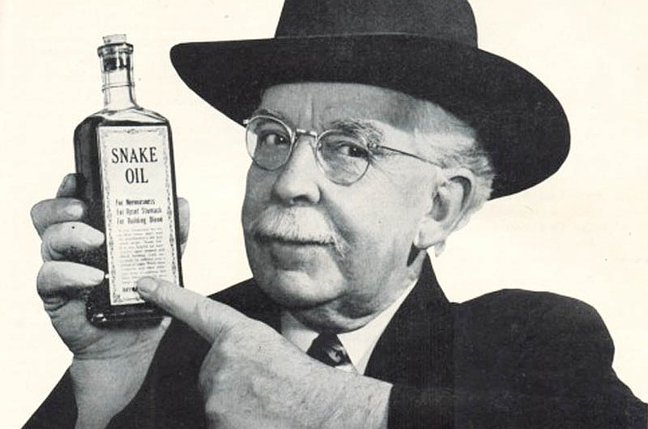
Snake Oil and Religion
Occasionally, I try to reach out to people who are still active Witnesses and pique their interest in critical examination of their faith. Perhaps it's overly optimistic to hope for a reaction, but you fail 100% of the times you don't try. So far, I'm batting 1.000. I'm not so disheartened that I'll quit, but I certainly don't expect to convert many. Sometimes the seed, however, will lay in wait until the soil is rich enough to let it sprout.
In having one of these conversations recently, I started to understand what one of the biggest road blocks is. It's the belief in the promises being sold by the society which can't be validated. It doesn't even have the dignity of a pyramid scheme in which the higher levels succeed by recruiting new subordinates. When you commit to being a Witness, you don't even have the Cinderella story of your forebears to look upon as a template. Their only claim to fame is that they've been waiting on the payout longer than the new ones. Success and perseverance are not the same thing.
Back in the old days, shysters and flim-flam men traveled from place to place offering miracle cure tinctures for a nickle a bottle. By the time anyone realized that his promises were bogus, he was in another town selling to the next bunch of rubes. And this is how they made their fortunes, off the hopes of the desperate and indigent.
It's not that religion appeals to the gullible that makes it so detestable. In fact, some of the most faithful people I've ever known were also some of the most intelligent. The real rub is that it's so easily accessible to people who have reached the end of their rope. Witnesses, like many other evangelicals, often claim to have met someone who had "just been praying to God for help". Humans are generally self-serving and don't turn to the almighty until all other avenues are exhausted. A promise, any promise, of relief from a grievous imposition is often enough to elicit a commitment from the afflicted person.
Often, these people have endured incessant pain. They have sought relief from every source they can find, even trying things that are unconventional and no less hokey than a deity. The stock and trade of the Witness movement is not that they have a special God. It's that their God is offering relief within the lifetimes of His followers. Every other religion brings a promise of eternity to the table, redeemable upon one's passing. To most people, that's just way too long to suffer. So finding a faith that promises a reward years, or even decades, sooner than any other belief systems makes it very appealing indeed.
That zeal produces its own placebo effect. The promise itself is so absolute that every minor taxation of time and effort seems like an infinitely appreciable investment. Nickle by nickle, the confidence-man extends the engagement of the audience while producing no tangible return. However, the people buying in feel better because of the assurances that the temporary measure offers as proof of God's love.
The conversation that led me to this realization is one that we've overheard numerous times. The conventions and assemblies always include the story of a person who wandered away and spent years in a miserable condition. This one was no different. After eight years as a disfellowshipped person, my friend from days gone by returned to the congregation; realizing only after a long isolation from her family just how "loving" the provision of disfellowshipping is. She called it a "protection for both sides". This is one of those catch phrases that the flim-flam man uses to convince people that it's the best course of action without any evidence to the same.
The reality is that the loving provision is a smoke screen that obscures the ineffectiveness of the treatment offered. It manufactures its own desperation as a result of the withdrawal. Back in those same good old days, the very tinctures that were offered were compounds that included powerful and addictive analgesics. Cocaine and heroin were often a mainstay in the one formula to the next. Indeed, it offered comfort, but no cure. But it also brought with it dependence. Taking away the customary therapy magnified the belief that it was effective, as my friend above experienced. Thus, the association, while bringing no actual remedy to the person in need, became a new and more powerful disease. There is only one cure for that.
The loneliness and isolation that we all experienced when we stepped away from the Society was a temporary but intense burden. There were times when it was nigh unbearable. But we made it through. Now, with the clarity of an unencumbered spirit, we can see the cure for what it is. An anesthetic that slows the senses and self-awareness of people who are being manipulated. The pain assuaged by the concoction just brings a new pain when taken away.
Sadly, its enough to keep too many going back for more.
Subscribe to:
Posts (Atom)